


 MENU
MENU
NEWS

How do you distinguish the top, middle, and base notes in an electronic air freshener?
Hello everyone, fellow agarwood enthusiasts!
The aroma of agarwood, a rare treasure of nature, offers a diverse range of sensory experiences: its fragrance, its sweetness, its lingering scent, its ethereal quality, and so on.
Some agarwood lovers dedicate their entire lives to the pursuit of the ultimate expression of agarwood's fragrance—
only the Creator of Nature possesses such power to present such a precious gift to humankind. This fragrance is incomparable to ordinary agarwood-based perfumes and fragrances.
Why do I say this?!
With today's advanced technology and precise computer analysis, even precious stones like diamonds can be replicated to look almost identical to the real thing. Foods made from these composites and raw materials taste nearly indistinguishable. Can agarwood surpass this?
The answer lies in the hearts of every agarwood enthusiast!
When burning agarwood powder, the aroma changes at different distances, creating layers of fragrance.
Normally, we smell the aroma from close to the incense burner, exhaling impurities...
but smelling it from close to the burner only reveals the initial notes. In fact, appreciating fragrance involves the initial, middle, and base notes!
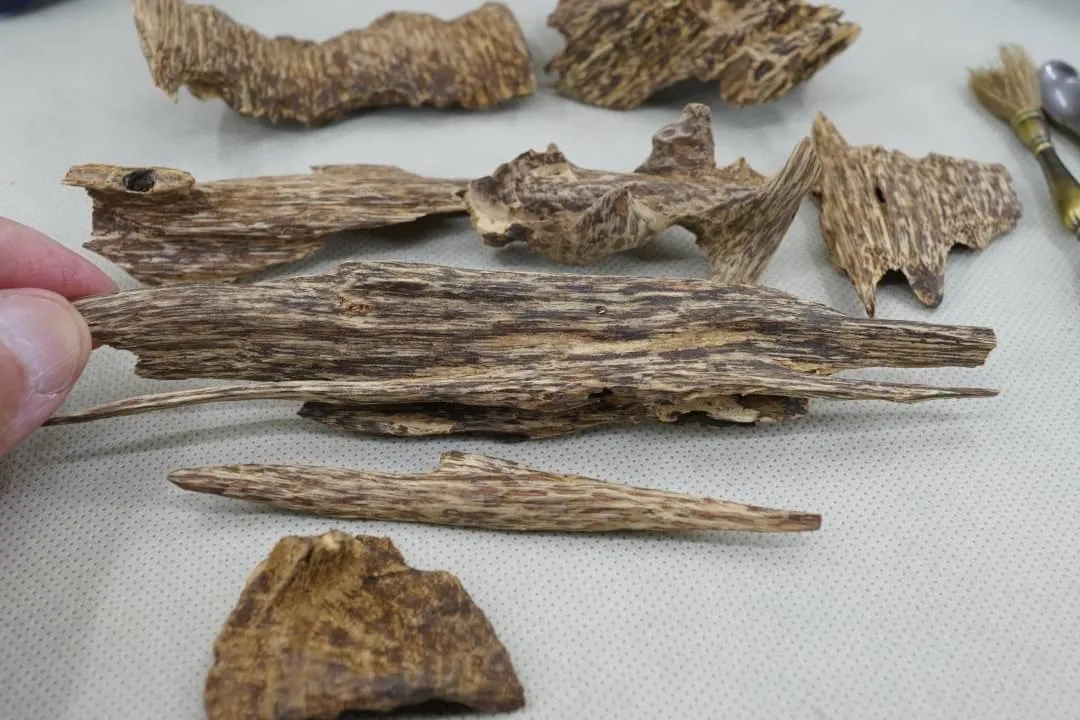
Taking Vietnamese Hue agarwood chips, with the recommended temperature at 1/3 of the setting, as an example:
The aroma of agarwood, a rare treasure of nature, offers a diverse range of sensory experiences: its fragrance, its sweetness, its lingering scent, its ethereal quality, and so on.
Some agarwood lovers dedicate their entire lives to the pursuit of the ultimate expression of agarwood's fragrance—
only the Creator of Nature possesses such power to present such a precious gift to humankind. This fragrance is incomparable to ordinary agarwood-based perfumes and fragrances.
Why do I say this?!
With today's advanced technology and precise computer analysis, even precious stones like diamonds can be replicated to look almost identical to the real thing. Foods made from these composites and raw materials taste nearly indistinguishable. Can agarwood surpass this?
The answer lies in the hearts of every agarwood enthusiast!
When burning agarwood powder, the aroma changes at different distances, creating layers of fragrance.
Normally, we smell the aroma from close to the incense burner, exhaling impurities...
but smelling it from close to the burner only reveals the initial notes. In fact, appreciating fragrance involves the initial, middle, and base notes!
Taking Vietnamese Hue agarwood chips, with the recommended temperature at 1/3 of the setting, as an example:
the first "initial note" is determined by the amount of agarwood used, based on your preferred strength of scent. The initial note is a light, milky fragrance.
(Depending on the type of agarwood, such as Indonesian agarwood, Cambodian agarwood, and Kyara, there are different top notes.)
Middle note: At a distance of about 15-25 cm from the incense burner (the distance varies depending on the type of agarwood), the aroma turns sweet and has a strong fragrance; I personally feel that the aroma is better at a distance than up close...
(Depending on the type of agarwood, such as Indonesian agarwood, Cambodian agarwood, and Kyara, there are different top notes.)
Middle note: At a distance of about 15-25 cm from the incense burner (the distance varies depending on the type of agarwood), the aroma turns sweet and has a strong fragrance; I personally feel that the aroma is better at a distance than up close...
Distant note: After a distance of 25 cm, the aroma changes and dissipates in the air... Sometimes the fragrance is sweet, and sometimes it cannot be smelled...
Agarwood enthusiasts often describe that when they burn incense indoors or in their study, and then return to the incense burner after a short time, the sudden burst of agarwood fragrance when they open the study door
is the most captivating~~ This distance is called the distant note.
Agarwood enthusiasts often experience difficulty smelling the fragrance of agarwood (excluding cases of physical discomfort or nasal congestion). It's recommended to temporarily stop smelling it, leave the area, and exhale deeply
before returning to the incense burner. This usually improves the situation!
Alternatively, prepare items with a strong aroma, such as coffee powder or strong tea leaves, and inhale them several times. Then, when you smell the agarwood again, you'll be able to appreciate its beauty!
Incense made from agarwood, such as small coils, incense sticks, or standing incense, is also smelled in the same way, although the aroma and fragrance won't be as strong as when agarwood chips are burned directly.
The above is provided for your reference. Please forgive any shortcomings.
Thank you.
Agarwood enthusiasts often describe that when they burn incense indoors or in their study, and then return to the incense burner after a short time, the sudden burst of agarwood fragrance when they open the study door
is the most captivating~~ This distance is called the distant note.
Agarwood enthusiasts often experience difficulty smelling the fragrance of agarwood (excluding cases of physical discomfort or nasal congestion). It's recommended to temporarily stop smelling it, leave the area, and exhale deeply
before returning to the incense burner. This usually improves the situation!
Alternatively, prepare items with a strong aroma, such as coffee powder or strong tea leaves, and inhale them several times. Then, when you smell the agarwood again, you'll be able to appreciate its beauty!
Incense made from agarwood, such as small coils, incense sticks, or standing incense, is also smelled in the same way, although the aroma and fragrance won't be as strong as when agarwood chips are burned directly.
The above is provided for your reference. Please forgive any shortcomings.
Thank you.
相關文章
 發信給店家
發信給店家 聯絡店家
聯絡店家 加入店家line好友